Stone & surfaces
Natural stone does not repeat.
Two slabs cut from the same block will differ in tone, movement and porosity. That is the material, not a defect — and it is why stone is quoted against a bundle or a selected slab rather than against a picture.
Stone arrives as a slab, a tile or a cut piece. Each is bought differently, and the difference is not cosmetic: a slab is selected by bundle, a tile is bought by the lot, and a cut piece is bought against a drawing.
We supply marble, granite, quartzite and travertine from domestic and international producers. Where a project needs continuity across several rooms, we quote the whole requirement against one bundle so the veining runs consistently rather than being matched afterwards from three separate deliveries.
For commercial work the specification usually names a test method rather than a trade name. Those tests are run by the producer and reported per lot; we pass the report on rather than paraphrasing it.
Formats
How stone is bought.
Thickness is the first decision and the one most often left until the fabricator asks. A 2 cm slab needs a laminated edge on a countertop; a 3 cm slab does not.
| Format | Sizes traded | Unit |
|---|---|---|
| Slab | 2 cm and 3 cm · typical 120×60 to 130×79 in · bundle of 6–8 | sq ft / bundle |
| Jumbo slab | 2 cm and 3 cm · 130×79 in and larger · selected by bundle | sq ft |
| Tile | 12×12, 12×24, 16×16, 18×18, 24×24 in · 3/8 and 1/2 in | sq ft / carton |
| Cut to size | Against a schedule or a drawing · tolerance stated per piece | sq ft |
| Countertop blank | Pre-fabricated 2 cm and 3 cm · 26 in and 36 in depth · 96 in and 108 in length | each |
| Paving | 20, 30, 40 mm · sawn or cleft · modular and random pattern | sq ft / pallet |
Finishes
The same stone, four ways.
Finish changes slip resistance, maintenance and how a colour reads under light. A honed floor and a polished floor in the same marble are not the same floor.
- Bianco
- Cool white, soft grey vein
- Calacatta
- Warm white, bold gold vein
- Travertine
- Beige, pitted, filled
- Limestone
- Taupe, even grain
- Quartzite
- Grey, hard, veined
- Slate
- Charcoal, cleft face
- Nero
- Near-black, white vein
- Absolute black
- Granite, fine grain
Finish definitions
- Polished
Gloss surface, sharp colour, reflective. Common on interior floors, walls and countertops. Slippery when wet.
- Honed
Matte, smooth, no reflection. Softer reading of the same colour. The usual choice for bathroom floors and for a low-sheen countertop.
- Brushed
Wire-brushed to a lightly textured, aged surface. Hides wear and water marks better than honed.
- Flamed
Thermally treated, rough and slip-resistant. Exterior paving and wet areas, most often in granite.
- Tumbled
Rounded edges and a worn face, produced in a tumbling drum. Traditional paving and wall finishes.
Edges & testing
What the fabricator needs to know.
An edge profile is a fabrication instruction, not a finish note. Specifying it late means re-cutting a finished piece.
Edge profiles
| Profile | Used for |
|---|---|
| Eased | A small round on a square edge. The default for a clean modern countertop. |
| Bevel | An angled cut. Reads as a thin edge and suits 3 cm material. |
| Bullnose | Full half-round. Pool coping, stair treads and any exposed corner. |
| Ogee | An S-curve. Traditional joinery, most often with a laminated 2 cm edge. |
| Laminated | A 4 cm built-up edge from 2 cm slab, to look like 4 cm solid. |
| Mitered | 45° return, matching the face vein down the edge. Waterfall ends and islands. |
Testing
Commercial specifications name a test method rather than a trade name. These are the ones most often asked for on stone; the producer runs them and reports per lot.
| Method | Measures |
|---|---|
| ASTM C97 | Absorption and bulk specific gravity — an indicator of porosity and staining risk. |
| ASTM C170 | Compressive strength of dimension stone. |
| ASTM C880 | Flexural strength — relevant to slab spans and cantilevers. |
| ASTM C241 | Abrasion resistance, used for flooring selection. |
| ANSI A326.3 | Dynamic coefficient of friction — the wet-slip test now specified in place of the old static test. |
Tile & pavers
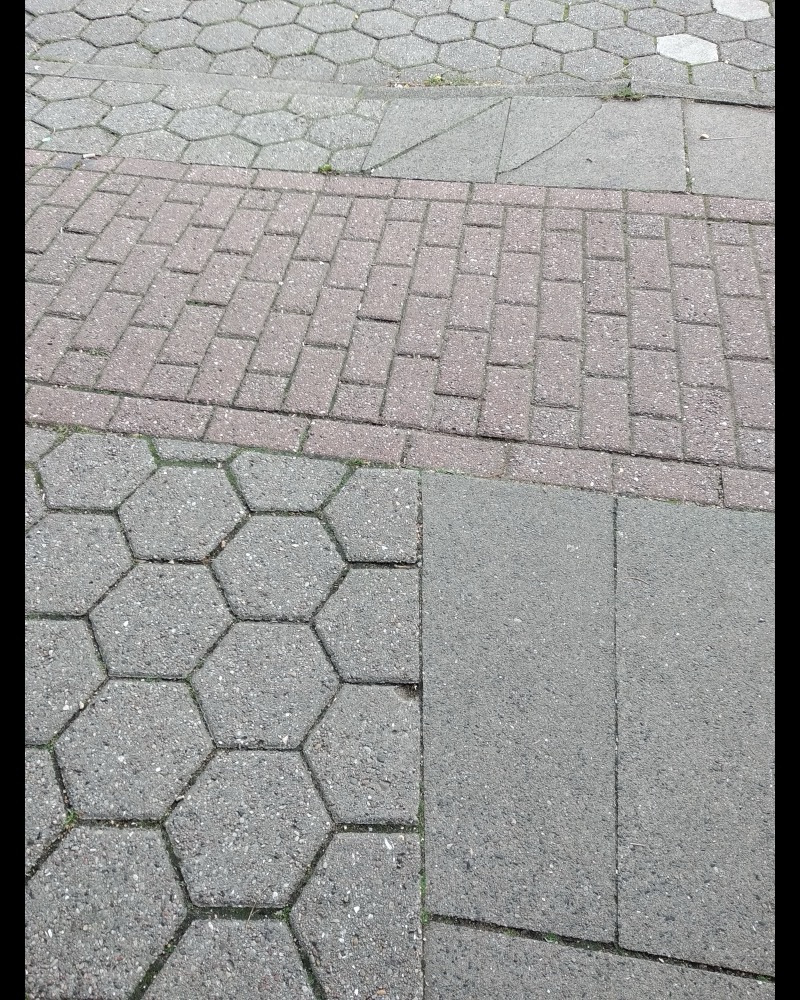
Same die lot, or a visible seam.
Tile is a manufactured product, so it is consistent within a lot and variable between lots. On a large area, the lot matters more than the sample board.
Ordering tile
- Order the whole area at once
Tile from a second lot can differ in shade and calibre. Buying the full quantity for a floor in one release avoids a visible transition halfway across a room.
- Add for cuts and breakage
Allowance depends on the format and the layout. A 24×24 in tile on a diagonal wastes more than a 12×12 in tile on a straight lay.
- Check calibre, not just size
Rectified tile is cut to a tight dimensional tolerance; pressed-edge tile is not. Mixing the two in one field shows at the joint.
- Match the setting material
Large-format tile needs a medium-bed mortar and often a levelling system. The wrong thin-set on a 24×48 in tile is a hollow floor.
- Pavers are not interior tile
Exterior paving is specified by thickness and by freeze–thaw performance, and is laid on a different substrate.
Stone enquiry
Send the drawing.
We will price the stone.
Bundle selection, finish, edge profile and thickness are the four things that change a stone price. Tell us those and the date, and the quotation can be specific.
Or email the trade desk at info@onesourcedepot.net